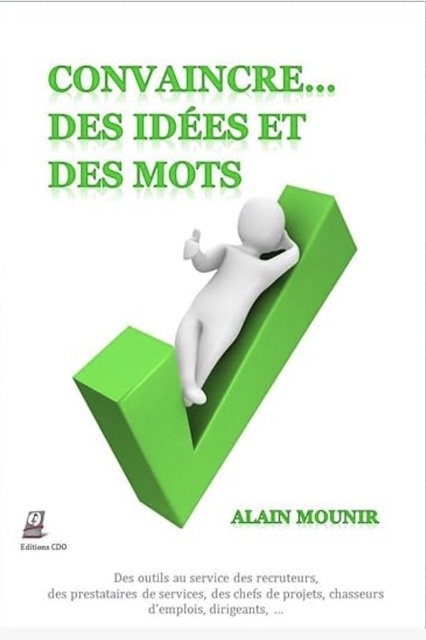
Convaincre... des idées et des mots

Consult this IA-Book and ask it your questions.
Editorial
Convincing is not imposing an idea. It is creating the conditions for it to be shared.
We have all experienced this situation: an idea seems obvious, relevant, sometimes even essential to us… and yet our interlocutor does not receive it as we imagined.
Why?
Because an idea never travels alone. It encounters another perception of the world, other experiences, other values, other beliefs, other needs — some expressed, many remaining implicit.
Convincing… ideas and words was born from this reality. The ambition of this work is not to learn to manipulate others, nor to provide some additional rhetorical recipes. It is to offer guidelines and tools to better understand what is at stake between an idea we want to convey and the way it will actually be perceived.
The common thread is deliberately pragmatic: first understand one’s own functioning and that of one’s interlocutor; distinguish what is said from what remains implicit; question rather than assume; clarify motivations to act; connect a proposal to the needs and values of the person who will receive it; and then build an argument that is both rational and emotionally relevant. This logic runs throughout the work.
Convincing then becomes less an oratory talent than a skill of understanding, structuring, and adapting.
This approach naturally finds its place in many professional situations: presenting a project, recruiting, job searching, leading a team, formulating an offer, handling an objection, giving or receiving feedback, defending a decision, or mobilizing a group. The book precisely outlines its tools in several of these contexts so that everyone can adapt them to their own reality.
Book content
Convincing... ideas and words offers a practical approach to understanding how an idea, project, or proposal can be better heard, understood, and accepted by an interlocutor.
The book starts from a simple observation: we never perceive a situation in exactly the same way. Our history, experiences, beliefs, values, and preferences influence our understanding of the world. Convincing therefore implies going beyond the intrinsic quality of an idea and focusing on how it will be received.
The reader gradually discovers a series of complementary tools: analysis of efficiency through Know-How, Want-to-Act, and Can-Act, exploration of explicit and implicit needs, logical levels of communication, open questions, motivations to act, values and beliefs, construction of arguments, handling objections, feedback, and presentation before a group.
Particular emphasis is placed on constructing a balanced proposal: understanding the client's need, clarifying what motivates commitment, and identifying the desired positive impact. The book also distinguishes between the emotional and rational dimensions of decision-making in order to adapt communication to the different sensitivities of interlocutors.
The final sections transform these principles into concrete situations arising from management, recruitment, project management, consulting, or job searching. They particularly illustrate how to argue in the face of doubt, structure feedback, or capture an audience's attention.
The whole defends a demanding yet respectful conception of persuasion: not to force agreement, but to provide the other with the information, meaning, and conditions that allow them to make their own choice.
The most distinguishing point of the book, especially in relation to your current work, seems to be less about "how to convince" than "why a just idea is not enough to convince." The manuscript already contains an idea that will clearly become central in your later works: making explicit what remains implicit. This is found in the search for unexpressed needs, the distinction between perception/reality, values and beliefs, and even in the necessity of clarifying the expected impact of an action.
About the author
Alain Mounir was born in 1961 in Switzerland. After training as a Microtechnology Engineer, he quickly became curious about the strategies and conditions that lead individuals to realize themselves through both personal and professional successes. After founding his company in 1989, he embarked on a long period of continuous training in the fields of psychology, behavior, neuroscience, etc. This training supports his services to executives and managers in companies: consulting, training, and coaching.
Attentive to developing solutions that meet not only today's needs but also tomorrow's requirements, he develops models and tools that constitute added value for his clients. A blend of systemic thinking, humanism, determinism, and foresight forms the foundation of his work. The maxim "efficiency is primarily about not doing anything unnecessary" complements his own: "working smart is better than working hard!"
Attentive to developing solutions that meet not only today's needs but also tomorrow's requirements, he develops models and tools that constitute added value for his clients. A blend of systemic thinking, humanism, determinism, and foresight forms the foundation of his work. The maxim "efficiency is primarily about not doing anything unnecessary" complements his own: "working smart is better than working hard!"