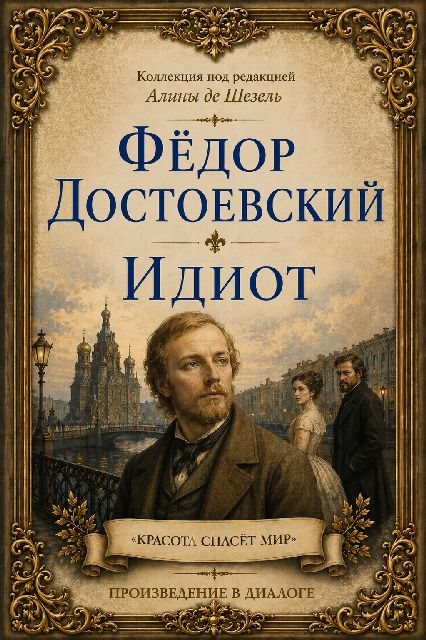
Fiodor Dostoievski - L'idiot

Consult this IA-Book and ask it your questions.
Editorial
It is with great pleasure that I present to readers "The Idiot" by Fyodor Mikhailovich Dostoevsky — the first work in our collection of Russian authors, which I have the honor to lead.
Starting this collection with Dostoevsky is by no means a random choice. Russian literature has gifted the world many great writers, but Dostoevsky's work occupies a completely special place within it. His works belong to their time and country, but the questions he poses have no boundaries or epochs. What is good? What does it mean to be free? Can one understand another person without judging them? Can compassion stand against violence, passion, pride, and selfishness? This is precisely why, more than a century and a half later, we continue to read Dostoevsky and recognize ourselves in his characters.
"The Idiot" seems to me to be an especially beautiful work to open this collection. Prince Myshkin enters society with sincerity, kindness, and an almost limitless capacity for compassion. And very quickly, an amazing paradox arises: it is precisely these qualities that make him appear to those around him as a strange, unadapted, and even ridiculous person. The title of the novel gradually turns into a question directed at each of us: who is truly the "idiot" here?
In creating this collection, I would like to offer not just the opportunity to reread the great works of Russian literature. I want to help the reader engage in a genuine dialogue with them. Behind the well-known titles, historical circumstances, and characters lie reflections on humanity that resonate remarkably with our present life.
This is where I see the special significance of the presence of Russian classics in IA-Book. The new form of reading does not replace the work and does not attempt to rewrite it. On the contrary, it invites us to return to the text, to ask it questions, to explore the characters' traits, to compare their choices with our own experiences, and to understand the author's thoughts more deeply.
"The Idiot" opens this collection, but it will be followed by other works and other voices of Russian literature. I hope that gradually a living space for meeting Pushkin, Tolstoy, Chekhov, Dostoevsky, and many other authors will emerge before the reader, rather than just a library of famous books.
It is a great joy for me to open this collection today with "The Idiot." And if, thanks to it, even some readers wish to discover Dostoevsky for the first time — or to reread him with new eyes — then this collection has already found its meaning.
**Alina de Chezelle**
*Head of the collection of Russian authors*
Book content
The novel "The Idiot," written by Fyodor Mikhailovich Dostoevsky and first published in 1868-1869, occupies a special place in the writer's oeuvre. At the center of the work is Prince Lev Nikolayevich Myshkin — a sincere, kind, compassionate man who is almost devoid of the usual societal drive for power, profit, and self-assertion. Returning to Russia after a long treatment in Switzerland, he finds himself in a world where human relationships are defined by money, passions, ambition, jealousy, and social conventions.
Dostoevsky sets himself an extraordinarily complex task: to show a person whose moral purity confronts the reality of society. It is this sincerity of Myshkin that leads those around him to perceive him as strange, naive, and even an "idiot." However, the question gradually arises: does the prince truly not understand the world around him — or, on the contrary, does he see people and their inner contradictions much more clearly than others?
One of the central figures of the novel is Nastasya Filippovna — a proud, vulnerable woman deeply traumatized by her past. Her relationships with Myshkin and the passionately in love Parfyon Rogozhin form the tragic center of the narrative. Caught between compassion, love, the desire for salvation, and destructive passion, the characters find themselves embroiled in a conflict from which it is almost impossible to emerge unscathed.
But "The Idiot" is significantly broader than a love drama. Through numerous characters and their confrontations, Dostoevsky explores human dignity, money, power, social status, the fear of death, religious faith, selfishness, and the capacity for compassion. Each character seems to offer their own answer to the question of how a person should live among others.
The special strength of the novel lies in the absence of simple moral solutions. Goodness in itself does not guarantee victory. Compassion may prove powerless against passion, and the desire to save another person can lead to tragedy. Myshkin is capable of understanding and forgiving, but his moral purity does not allow him to change the surrounding world.
"The Idiot" compels the reader to reflect on a paradox that remains relevant today: what happens to a truly good person in a society built on competition, interests, and social roles? And who in such a world should be considered the "idiot" — the one who refuses to live by its rules, or those who see these rules as the only possible ones?
About the author
Fyodor Mikhailovich Dostoevsky (1821–1881) is one of the greatest Russian writers and thinkers of the 19th century, whose work has had a tremendous impact on world literature, philosophy, and the understanding of human psychology. His works explore the deepest contradictions of human nature: freedom and responsibility, good and evil, faith and doubt, love and hatred, suffering, guilt, and the possibility of moral rebirth.
Dostoevsky was born in Moscow into a family of a doctor. After receiving an engineering education in St. Petersburg, he soon abandoned a military career to devote himself to literature. His first novel, "Poor Folk," published in 1846, attracted the attention of literary circles. However, the writer's fate changed dramatically after his involvement in the Petrashevsky circle. In 1849, Dostoevsky was arrested and sentenced to death. At the last moment, the execution was commuted to hard labor. The four years spent in Siberia, followed by military service, became a decisive experience that profoundly changed his worldview.
After returning to literary activity, Dostoevsky created works that would bring him worldwide fame: "Notes from Underground," "Crime and Punishment," "The Idiot," "Demons," "The Adolescent," and "The Brothers Karamazov." In these novels, the plot becomes a space for the clash of ideas, beliefs, and moral choices. His heroes do not just act—they argue, doubt, suffer, try to understand themselves, and define the boundaries of their own freedom.
A special place in Dostoevsky's work is occupied by the question of a person's responsibility for their actions. Can an idea justify a crime? Where is the line between freedom and destruction? Is moral rebirth possible after a fall? What happens to a person when reason comes into conflict with conscience? These questions run through the entire oeuvre of the writer and remain remarkably contemporary.
Dostoevsky had an exceptional ability to depict the internal conflicts of a person. Long before the emergence of modern psychology, he explored the mechanisms of fear, guilt, self-deception, addiction, humiliation, and the desire for recognition. This is why his works later attracted the attention of philosophers, psychologists, and thinkers of various directions.
But Dostoevsky is not only a writer of human suffering. At the center of his world is also the possibility of transforming a person through compassion, love, faith, and acceptance of responsibility. Even his most tragic characters retain the possibility of choice.
Reading Dostoevsky today means entering into a dialogue not only with a great Russian writer of the 19th century but also with a thinker who poses to each reader one of the most difficult questions: what does it mean to be human when no simple answer is possible?