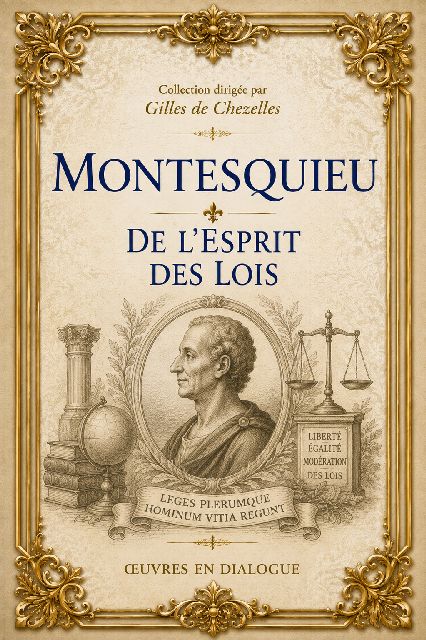
Montesquieu - L'esprit des lois

Consult this IA-Book and ask it your questions.
Editorial
A work transcends time because it continues to speak to us. Behind the words of an author, we discover an era, a sensitivity, a way of looking at the world. We also encounter questions that remain ours: how to live, understand others, exercise our freedom, face uncertainty, or give meaning to our choices?
The collection "An Author, a Work" was born from this conviction: texts deserve to be accessible to everyone, without their richness being reduced to a few formulas or a single interpretation. It offers the opportunity to meet an author through a work, and then to extend this encounter through a dialogue tailored to one's curiosity.
With IA-Book, the reader can question the text, ask for an explanation of a passage, explore an idea, clarify a reference, or confront multiple interpretations. They can proceed at their own pace, starting from a simple question, delving deeper into a theme, or revisiting what surprised them. Each question thus becomes an entry point into the work.
This approach supports reading and invites a return to the text with a more attentive eye. An answer can help with understanding; it can also give rise to a fruitful doubt, an objection, or the desire to continue. The reader retains their place: that of a free spirit who examines, connects, discusses, and builds their own judgment.
Encountering a work also requires taking into account the distance that sometimes separates us from its author. Words, usages, knowledge, and convictions evolve. Understanding a text therefore implies placing it back in its context while questioning what it can still teach us today. Drawing parallels with our time opens up perspectives, provided we distinguish what the author wrote from the extensions we propose.
Artificial intelligence brings a new possibility for exploration here. Its responses remain proposals for reading: they may contain approximations and, when necessary, call for verification in the work or from reliable sources. This vigilance fully contributes to the ambition of the collection: to promote informed understanding and the autonomy of the reader.
No prior knowledge is necessary to begin. All it takes is curiosity, astonishment, a question. Whether you are discovering this author or revisiting them after several years, this book invites you to take the time to listen, and then to engage in conversation with their thought and universe.
An author, a work, and now your questions: the encounter can begin.
Book content
Why do laws differ from one society to another? What drives a government to act? How can we prevent the abuse of power and preserve freedom? In De l'esprit des lois, published in 1748, Montesquieu connects these questions through a comparative investigation of institutions and their conditions.
This AI-Book focuses on the selection contained in the provided file. It includes books I to VIII, XI, and XIX, as well as chapters I to V of book XV and IX to XIII of book XXV. It does not provide access to the entirety of the thirty-one books of the work.
The first books present laws and forms of government: republic, monarchy, and despotism. Montesquieu distinguishes their organization and the spring that makes them function. He then examines education, equality, justice, punishments, luxury, and the corruption of political principles.
Book XI studies freedom in relation to the constitution and the distribution of powers. The excerpts from book XV discuss slavery and its justifications, notably through irony. Book XIX outlines the relationships between laws, morals, manners, and the general spirit of a nation. The excerpts from book XXV question tolerance and religious persecution.
You may ask why freedom does not mean doing whatever one wants, how one institution can limit another, or why the severity of punishments does not guarantee better justice. You can also explore the relationships between education and regime, between equality and corruption, or between written rules and social practices.
The attached file includes a praise of d'Alembert and a critical introduction, to be distinguished from Montesquieu's text. The reference documentation and glossary clarify the available scope and explain historical notions; the proposed questions open several reading pathways.
The challenge is to understand a thought on diversity and the limitation of power, discussing its arguments and limits. Contemporary comparisons can illuminate the reading, provided that the difference between the institutions of the eighteenth century and ours is maintained.
About the author
Charles-Louis de Secondat, Baron de La Brède and de Montesquieu, was born in 1689 near Bordeaux and died in Paris in 1755. A magistrate, writer, and Enlightenment thinker, he uses the comparison of societies as a means to understand laws and forms of power.
President at the Parliament of Bordeaux from 1716, he has an insider's knowledge of the judicial institutions of the Ancien Régime. His scholarly activity, readings, and travels broaden this experience. A stay in England particularly enriches his reflection on the relationships between powers and the guarantees of freedom.
The Persian Letters, published in 1721, give him literary notoriety. The detour through the perspective of foreign travelers allows for questioning European customs. The Considerations on the Causes of the Greatness of the Romans and Their Decline, in 1734, develops historical inquiry. The Spirit of the Laws, in 1748, offers a much broader study of the relationships between institutions, morals, and living conditions.
Montesquieu does not seek a single law to impose everywhere. He examines how rules function in different situations. His distinction between republic, monarchy, and despotism serves to study the mechanisms of governments; his reflection on freedom emphasizes the limits that must be placed on the abuse of power.
His work evokes admiration and controversy. He responds to his critics in the Defense of the Spirit of the Laws, published in 1750. His thought leaves a lasting mark on constitutional debates and the study of societies.
However, reading must maintain historical distance. Montesquieu remains a man of his century and social position: his conceptions of representation, orders, women, and peoples do not align with current principles. His importance also lies in the distinctions and questions that allow for discussion of his own analyses.