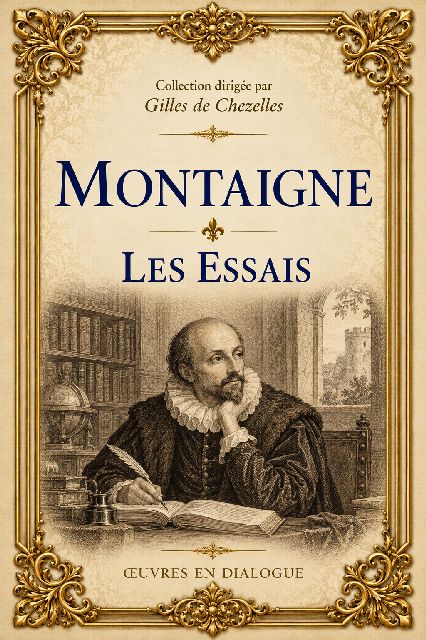
Montaigne - Les essais

Consult this IA-Book and ask it your questions.
Editorial
A work transcends time because it continues to speak to us. Behind the words of an author, we discover an era, a sensitivity, a way of looking at the world. We also encounter questions that remain ours: how to live, understand others, exercise our freedom, face uncertainty, or give meaning to our choices?
The collection "An Author, A Work" was born from this conviction: texts deserve to be accessible to everyone, without their richness being reduced to a few formulas or a single interpretation. It offers the opportunity to meet an author through a work, and then to extend this encounter through a dialogue tailored to one's curiosity.
With IA-Book, the reader can question the text, ask for an explanation of a passage, explore an idea, clarify a reference, or confront multiple interpretations. They can proceed at their own pace, starting from a simple question, delving deeper into a theme, or revisiting what surprised them. Each question thus becomes an entry point into the work.
This approach supports reading and invites a return to the text with a more attentive eye. An answer can help with understanding; it can also give rise to a fruitful doubt, an objection, or the desire to continue. The reader retains their place: that of a free spirit who examines, connects, discusses, and builds their own judgment.
Encountering a work also requires taking into account the distance that sometimes separates us from its author. Words, usages, knowledge, and convictions evolve. Understanding a text therefore implies placing it back in its context while questioning what it can still teach us today. Drawing parallels with our time opens up perspectives, provided we distinguish what the author wrote from the extensions we propose.
Artificial intelligence brings a new possibility for exploration here. Its responses remain proposals for reading: they may contain approximations and, when necessary, call for verification in the work or from reliable sources. This vigilance fully contributes to the ambition of the collection: to promote informed understanding and the autonomy of the reader.
No prior knowledge is necessary to begin. All it takes is curiosity, astonishment, a question. Whether you are discovering this author or revisiting them after several years, this book invites you to take the time to listen, and then to engage in conversation with their thought and universe.
An author, a work, and now your questions: the encounter can begin.
Book content
The Essays explore a question that runs through an entire existence: how to live and judge within the limits of our condition? Drawing from his readings, encounters, body, and responsibilities, Montaigne examines human behaviors without confining them to a single doctrine.
The work consists of three books. The first two were published in 1580; the third joined them in the augmented edition of 1588. Montaigne continued to make additions until his death, before the posthumous publication in 1595. This process of revision contributes to the fluid nature of the text: one idea calls for an example, an objection shifts it, a personal experience tests its significance.
This IA-Book takes as its corpus the three books provided in EPUB, whose metadata indicates 1595. The text retains an archaic spelling. The numbering of certain chapters in book I differs from that of other editions, so the titles serve as the most reliable markers for navigating the work.
You can question Montaigne about the formation of judgment, the critique of pedantry, the friendship with La Boétie, or the power of custom. You can also compare Des Cannibales and Des Coches, examine the critique of cruelty, explore doubt in the Apology of Raimond de Sebonde, or follow the reflection on the body and death up to De l'experience.
The author's presentation provides context on the Renaissance, the Wars of Religion, his readings, and his public responsibilities. The glossary explains important concepts and some old meanings; the proposed questions offer several starting points. The chapters of the Essays remain the main reference for illuminating each topic.
The work lends itself to a continuous reading as well as thematic pathways. It invites comparisons of passages, distinguishes a reported opinion from the author's position, and places famous formulas within their context. Comparisons with our current concerns can open the discussion, provided that we do not attribute to Montaigne ideas he did not express.
About the author
Michel Eyquem de Montaigne was born in 1533 in Périgord and died in 1592 in his castle. A writer of the Renaissance, trained in ancient letters, he was also a man engaged in the life of his time: a magistrate at the Bordeaux parliament, a landowner, a traveler, and mayor of Bordeaux from 1581 to 1585.
This diversity of experiences nourishes Les Essais. Montaigne questions received opinions, social customs, education, friendship, violence, illness, and death. He does not compose a philosophical system: he tests his judgments against books, events, and self-observation.
His friendship with Étienne de La Boétie, who passed away in 1563, profoundly marks his work. The Wars of Religion give a particular urgency to his attention to collective passions, cruelty, and the dangers of certainty. A Catholic, he remains attached to his beliefs while exploring the limits of human reason and the effects of customs on our convictions.
Plutarch, Seneca, and Latin poets are his interlocutors. He takes their examples, discusses them, and confronts them with his own condition. His critique of pedantry defends knowledge that shapes judgment rather than erudition intended to impress.
The first two books of the Essais were published in 1580. An expanded edition in 1588 added the third book; Montaigne then continued to enrich his text. Marie de Gournay plays an essential role in its posthumous publication in 1595 and in its transmission.
Montaigne remains read for his freedom of composition, his attention to human contradictions, and his way of making thought accessible in its very movement. His personal portrait invites us to examine our own certainties while preserving the distance between the world of the 16th century and our own.