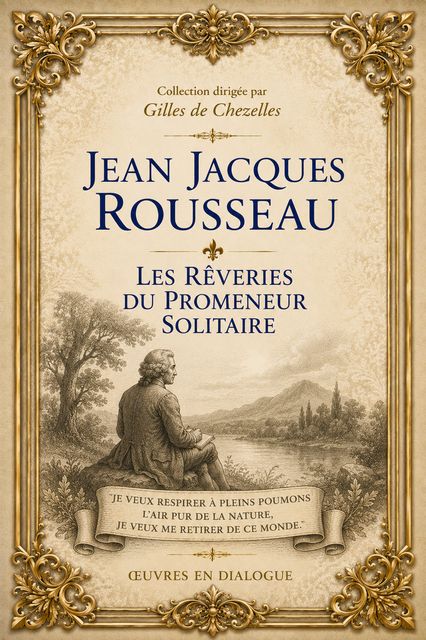
Jean Jacques Rousseau - Les reveries du promeneur solitaire

Consult this IA-Book and ask it your questions.
Editorial
A work transcends time because it continues to speak to us. Behind the words of an author, we discover an era, a sensitivity, a way of looking at the world. We also encounter questions that remain ours: how to live, understand others, exercise freedom, confront uncertainty, or give meaning to our choices?
The collection "An Author, a Work" was born from this conviction: texts deserve to be accessible to everyone, without their richness being reduced to a few formulas or a single interpretation. It proposes to meet an author through a work, and then to extend this encounter through a dialogue tailored to one's curiosity.
With IA-Book, the reader can question the text, ask for an explanation of a passage, explore an idea, clarify a reference, or confront multiple interpretations. They can proceed at their own pace, starting from a simple question, deepening a theme, or revisiting what surprised them. Each question thus becomes an entry point into the work.
This approach supports reading and invites a return to the text with a more attentive eye. An answer can help with understanding; it can also give rise to a fruitful doubt, an objection, or the desire to continue. The reader retains their place: that of a free spirit who examines, connects, discusses, and builds their own judgment.
Encountering a work also requires taking into account the distance that sometimes separates us from its author. Words, usages, knowledge, and convictions evolve. Understanding a text therefore implies placing it back in its context while questioning what it can still teach us today. Drawing parallels with our time opens up perspectives, provided we distinguish what the author wrote from the extensions we propose.
Artificial intelligence offers a new possibility for exploration here. Its responses remain proposals for reading: they may contain approximations and call for verification in the work or from reliable sources when necessary. This vigilance fully contributes to the ambition of the collection: to promote informed understanding and the autonomy of the reader.
No prior knowledge is necessary to begin. All it takes is curiosity, astonishment, a question. Whether you are discovering this author or revisiting them after several years, this book invites you to take the time to listen, and then to engage in conversation with their thought and universe.
An author, a work, and now your questions: the encounter can begin.
Book content
Through ten walks, Rousseau reflects on his life, his wounds, and the moments when he felt the happiness of existence. Walking brings forth memories; a reading leads to examining lies; a plant revives a vanished place; a meeting reveals that the bond with others is never entirely broken.
Written between 1776 and 1778 and published in 1782, after the author's death, The Reveries of the Solitary Walker constitutes an unfinished work. They do not follow the continuous order of a life: they combine meditation, narrative, description, and moral examination. The tenth walk, dedicated to the memory of Madame de Warens, remains interrupted.
This AI-Book takes as its corpus the ten walks present in the provided file. It allows for questioning their themes and relating passages: the project of writing for oneself, the experience of an accident, reflection on truth, the memory of Saint-Pierre Island, the difficulties of charity, botany, and encounters with children or strangers.
At the heart of the book lies a question: how to regain a sense of self when one feels dependent on the judgment of others? The fifth walk explores the feeling of existence in contact with Lake Bienne. Other passages examine the limits of this peace, the return of worries, and the resources of memory.
The documentation on Rousseau situates the work within his journey and the debates of his time. The glossary explains useful concepts, while the proposed questions open several paths for reading. Other works by Rousseau are mentioned as context; they are not fully included in this corpus.
The responses distinguish the narrator's voice, historical facts, and interpretations. They allow for understanding the feeling of persecution without taking each accusation as established, and for examining sincerity without assuming infallible memory.
The work invites a careful reading of its contrasts: solitude and attachment, claimed innocence and acknowledged faults, worry and gentleness. It offers a way to question the relationship to oneself, to others, and to places, while preserving the uniqueness of Rousseau's voice.
About the author
Jean-Jacques Rousseau was born in Geneva in 1712 and died in Ermenonville in 1778. A writer and philosopher of the French language, he was also a musician, composer, and passionate observer of plants. His work explores the relationships between freedom, society, education, and emotional life.
His education combines readings, travels, encounters, and various activities. Madame de Warens plays a decisive role in his youth; the Charmettes, near Chambéry, remain a privileged place in his memory. In Paris, he frequents intellectual circles and participates in the Encyclopédie, particularly in the musical field.
The Discours sur les sciences et les arts brings him recognition in 1750. He then publishes the Discours sur l'inégalité, Julie ou La Nouvelle Héloïse, Du contrat social, and Émile. His affiliation with the Enlightenment is marked by disagreements: he contests the assimilation of the progress of knowledge to moral progress and questions the forms of dependence produced by social life.
The condemnations of 1762 lead to displacements and exiles. Conflicts with several contemporaries fuel a growing need to defend himself and narrate his own existence. The Confessions, the Dialogues, and then Les Rêveries du promeneur solitaire give different forms to this search for personal truth.
Rousseau does not allow himself to be reduced to a harmonious figure. His reflection on education coexists with the abandonment of his children to the Enfants-Trouvés; his desire for solitude with a deep need for affection and recognition. Reading his texts requires considering these tensions, without erasing them or making them the sole explanation of his work.
In the Rêveries, written at the end of his life, attention to the landscape, memories, and sensations accompanies a sometimes anxious, sometimes calm self-examination. This writing has durably marked literature on inner life and representations of the relationship between human beings and nature.