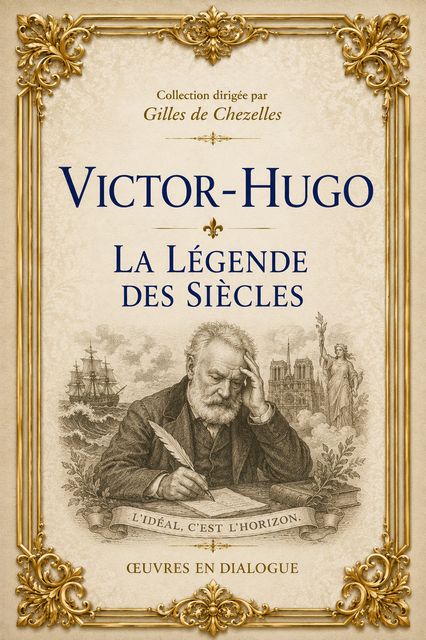
Victor Hugo - La légende des siècles

Consult this IA-Book and ask it your questions.
Editorial
It was necessary to choose a work to open this collection. And to choose is always to renounce.
I could have started with a shorter text, more immediately accessible, perhaps even more reassuring. I preferred La Légende des siècles by Victor Hugo because it represents, in my eyes, exactly what this collection wishes to make possible: to return to great works, not to confine them in the respect we owe to the classics, but to rediscover with them the pleasure of discovery, reflection, and dialogue.
La Légende des siècles is a singular book. Victor Hugo traverses epochs, civilizations, myths, and beliefs to tell a story that surpasses all others: that of humanity.
We encounter kings and prophets, warriors and children, the powerful and the miserable. We cross paths with greatness and cruelty, hope and fear, justice and tyranny. Behind this multitude of characters and narratives, a single question constantly resurfaces: does man truly progress?
This question seems extraordinarily relevant to me.
Our knowledge has progressed, our technologies have transformed our daily lives, and we have means that Victor Hugo would probably never have imagined. But the questions he raises remain: those of power, freedom, conscience, responsibility, violence, justice, and our ability to build a better world.
This is also why La Légende des siècles naturally finds its place in IA-Book.
Technology today offers us a new possibility: to not only read a great work but to explore it differently. To ask a question, search for an idea, connect two passages, revisit a character, or attempt to understand what a text written over a century ago can still tell us today.
It is obviously not about making Victor Hugo speak for us, let alone attributing thoughts to him that he would never have expressed. It is, on the contrary, about returning to his work, traversing it, questioning it, and perhaps discovering things we would not have noticed during a traditional reading.
This is precisely the ambition of this collection: to use the possibilities of artificial intelligence not to replace works, but to give us an additional reason to read them, understand them, and bring them to life.
That La Légende des siècles is the first book seems quite natural to me.
Victor Hugo wanted to tell the march of humanity.
It is now up to us to enter this story and continue the dialogue.
Gilles de Chezelles
Director of the collection
Book content
The Legend of the Centuries is one of Victor Hugo's most ambitious works. Published in several stages between 1859 and 1883, it brings together dozens of poems through which the author seeks to tell not the exact history of humanity, but its symbolic journey through the centuries.
From biblical times to the modern era, Victor Hugo brings forth historical, legendary, or imaginary characters. Kings, prophets, knights, tyrants, heroes, children, the poor, and the anonymous succeed one another to compose a vast fresco in which individual destinies become witnesses to a collective adventure: that of man confronted with power, violence, justice, freedom, and progress.
Hugo does not seek to write a history book. He uses history, myths, and legends to question humanity. Each era becomes the theater of a confrontation between light and shadow, between barbarism and civilization, between oppression and freedom.
Some poems have become particularly famous. *La Conscience* revisits the biblical story of Cain pursued by the gaze of God after the murder of his brother. *Booz endormi* transforms a biblical episode into a meditation on love, old age, and transmission. In other texts, Hugo evokes the knights of the Middle Ages, the great figures of power, or the anonymous swept away by events.
Behind this extraordinary diversity lies an essential conviction of Victor Hugo: despite the wars, tyrannies, and crimes that mark its history, humanity can progress. This progress is neither simple nor continuous. It results from a permanent struggle between force and right, ignorance and knowledge, domination and freedom.
The Legend of the Centuries is thus both a poetic, philosophical, and deeply political work. Victor Hugo observes the past to reflect on the future. He questions what makes the greatness or weakness of man and seeks, behind the succession of civilizations, a possible direction given to human history.
Nearly two centuries later, these questions remain surprisingly relevant: what is progress? Does civilization truly protect us from barbarism? Why do men sometimes accept tyranny? Can conscience be stronger than power?
With IA-Book, The Legend of the Centuries thus becomes a work that can be explored but also questioned, to discover how Victor Hugo used the past to speak to the men of his time — and perhaps, to those of ours.
About the author
Victor Hugo (1802-1885) is one of the major figures of French literature and one of the most emblematic writers of the 19th century. Poet, novelist, playwright, essayist, politician, and engaged intellectual, he created an immense body of work that brings together literature, history, philosophy, and reflection on society.
As a leader of French Romanticism, Hugo early on disrupted the literary conventions of his time. In theater, particularly with Hernani and Ruy Blas, he claims a new freedom in dramatic creation. In poetry, from Les Contemplations to La Légende des siècles, he explores both the intimate and the fate of humanity, blending personal memories, meditation, history, spirituality, and questioning progress.
His novels are among the most famous works of world literature. Notre-Dame de Paris brings to life medieval Paris while giving a voice to rejected or marginalized beings. With Les Misérables, Victor Hugo constructs a vast social fresco around characters that have become universal: Jean Valjean, Javert, Fantine, Cosette, or Gavroche. Behind their destinies lie questions that remain relevant today: what is justice? Can one change? What responsibility does society bear in misery? How far should the law go? What place should be given to compassion?
For Victor Hugo is not just a writer. He is also a passionate witness and actor of his century. A deputy and then senator, an opponent of Napoleon III, he experiences nearly twenty years of exile. He intervenes in the major debates of his time and notably defends freedom of expression, education, the fight against misery, and the abolition of the death penalty.
His work is thus permeated by a deep conviction: literature can help illuminate humanity and transform society.
Reading Victor Hugo today is therefore not just about discovering a monument of literature. It is about encountering a man who constantly questions his time, its contradictions, and its injustices, while reflecting on profoundly human questions: freedom, love, suffering, responsibility, conscience, power, justice, and hope.
With IA-Book, this work can become a space for dialogue. The reader can question it, relate different texts, explore a character, an idea, or an era, and seek, through the words of Victor Hugo, what they can still teach us about our own world.